Counting the outcomes
THE MATHEMATICS
| Outcome | one result the mechanism can produce |
|---|---|
| Probability | winning outcomes divided by all outcomes |
| Odds against | losing outcomes to winning outcomes |
| Payout | what the game pays for a winning unit |
| Expected value | probability × payout, summed over outcomes |
Almost everything on this site rests on one idea: if you can list the outcomes of a mechanism and argue that they are equally likely, you can count them, and once you can count them you can price anything built on top of them. A fair coin has two outcomes. A die has six. Two dice have thirty-six, and it matters that they are thirty-six and not eleven, because a four and a three is a different outcome from a three and a four even though both make seven.
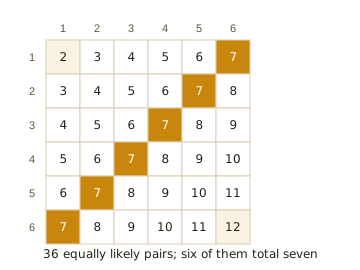
That distinction is the single most common error in casual reasoning about chance. The eleven possible totals are not equally likely. Seven can be made six ways, two can be made one way, so seven arrives six times as often as snake eyes. The grid above is the whole argument: thirty-six cells, each as likely as any other, and the totals distributed unevenly across them.
Odds and probability say the same thing in different grammar. A probability of one in thirty-seven is odds of thirty-six to one against. Probability is a fraction of all outcomes; odds compare the losing outcomes to the winning ones. Games quote payouts in the odds form, which is why the comparison that matters is always between the true odds against an event and the odds the game pays for it.
When outcomes are drawn without replacement the counting changes, because each draw alters what remains. Choosing six numbers from forty-nine is not six independent choices from forty-nine: it is a combination, and the number of possible tickets is the number of ways to choose six items from forty-nine when order does not matter. That number is 13,983,816, and it is obtained by multiplying 49 × 48 × 47 × 46 × 45 × 44 and dividing by the 720 orderings of any six chosen numbers.
Expected value ties the two halves together. Multiply each outcome's probability by what it returns, add the results, and you have the average result of one play repeated indefinitely. It is not a prediction about any single play. It is the number that the average of many plays moves towards, and every figure in the index is that number.
Worked example: any seven at the dice table.
Six of the thirty-six pairs total seven, so the probability is 6/36 = 1/6 and the true odds against are five to one.
The bet pays four to one. Expected result on one unit = (1/6 × 4) − (5/6 × 1) = (4 − 5)/6 = −1/6 = −16.67%.
The mechanism is fair. The price is not.