How a game is built to a number
HOW GAMES ARE MADE
| Return | share of stakes paid back over the long run |
|---|---|
| Hold | share retained; the complement of return |
| Hit rate | how often any winning outcome occurs |
| Volatility | how unevenly the return is distributed |
| Worked example on this site | 86.75% return, 13.25% hold |
Commercial games are not invented and then measured. The target return is chosen first, and everything else is arranged to produce it. That inversion explains most of what a player experiences at a table or a machine: the theme, the sounds, the near-misses and the bonus rounds are all downstream of a number that was decided before any of them existed.
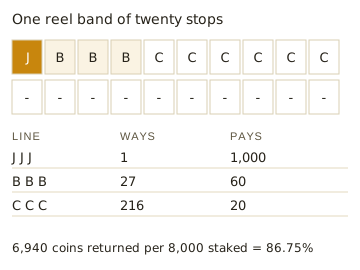
For a reel machine the working document is a par sheet: the symbol counts on each reel, the pay table, and the resulting probability and contribution of every winning combination. Each line's contribution is its probability multiplied by its payout, and the sum of the contributions is the return. Changing one symbol count on one reel changes several lines at once, so the sheet is adjusted iteratively until the total lands on the target. The worked example on this site is a miniature version of exactly that document.
Hit rate is independent of return, and this is the most useful thing a player can understand about machine design. A game returning ninety per cent can pay something back on a third of spins in small amounts, or on one spin in twenty in large ones. Both return ninety per cent. The first feels generous and drains a bankroll steadily; the second feels barren and occasionally does something dramatic. Designers choose between them deliberately, because they suit different players and different session lengths.
Volatility is the same dial described statistically, and it is what determines how long a player can play before the expected loss shows through. High-volatility games have enormous variance, so a session result tells you almost nothing about the game's actual return, and a player may be far ahead or far behind for a very long time. That is a feature: the arithmetic of the game is least visible precisely where the swings are largest.
Table games are designed the same way with different levers. The designer's dials are the payout schedule, the drawing rules, whether a charge is applied to the more likely side, and which side bets are offered alongside the main game. Side bets are where most of the margin on a modern table lives, because a headline game must remain competitive on its published figure while a named side bet with a big multiple can carry five or ten times the cost without drawing comparison.