Card games
THE GAMES
| Baccarat banker, five per cent charge | −1.06% |
|---|---|
| Baccarat player | −1.24% |
| Baccarat tie at eight to one | −14.36% |
| Player pair at eleven to one, eight decks | −10.36% |
| Blackjack insurance, one deck, ace up | −5.88% |
| Blackjack to a fixed strategy | −0.40% to −2.00%, rules-dependent |
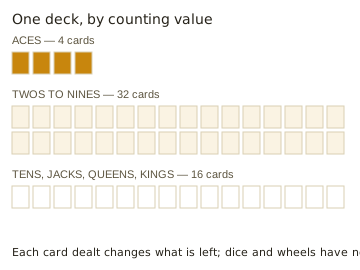
Cards differ from wheels and dice in one decisive respect: they are drawn without replacement. Every card dealt changes the composition of what remains, so the probabilities on the next hand are not the probabilities on the last. This is the only mechanism in common use that carries information forward, and almost everything distinctive about card games follows from it.
Where the drawing rules are entirely fixed, the arithmetic is finite and can be enumerated exhaustively. Baccarat is the clearest example: no player decision affects any card, both hands are drawn by a published table, and so the whole game can be enumerated to give the banker hand a cost of 1.06 per cent after the five per cent charge on winning banker bets, and the player hand 1.24 per cent. The charge exists precisely because the banker hand wins slightly more often than the player hand; without it the operator would be offering an even-money bet on the more likely side.
Side bets on card games are usually far more expensive, and the reason is visible in a single calculation. The pair side bet asks whether the two cards dealt to one hand match in rank. With eight decks the first card is any card, and thirty-one of the remaining four hundred and fifteen match it, so the probability is 31/415. At eleven to one, the expected value is (31 × 11 − 384)/415 = −43/415, or 10.36 per cent. A bet with a memorable name and a large advertised multiple usually costs several times the main game it sits beside.
Insurance in blackjack is the same trap in miniature. With one deck and only the dealer's ace exposed, sixteen of the fifty-one unseen cards give the dealer a natural. At two to one, the expected value is (16 × 2 − 35)/51 = −3/51, or 5.88 per cent. It is offered as protection and priced as a side bet, and it is the one bet at the table whose cost changes sharply with what has already been dealt, which is why it is the bet a counting player treats differently from every other.
Blackjack itself resists a single number, and this site does not publish one. The cost depends on the number of decks, whether the dealer draws on a soft seventeen, what doubling and splitting are permitted, what a natural pays, and how closely the player follows an optimal strategy. Under liberal rules and accurate play the figure is a few tenths of one per cent; under restrictive rules, or with a shortened payout on naturals, it multiplies several times over. A single published percentage for blackjack is a statement about a rule set, not about a game.
Every card entry in the index
- Blackjack, played to a fixed strategy0.40%–2.00%
CARDS / RULE-DEPENDENT / SEE RANGE
- Baccarat, banker with five per cent charge1.06%
CARDS / FIXED DRAWING RULES
- Baccarat, player1.24%
CARDS / FIXED DRAWING RULES
- Blackjack insurance, one deck, ace exposed5.88%
CARDS / 51 UNSEEN / PAYS 2 TO 1
- Player pair side bet, eight decks10.36%
CARDS / 415 UNSEEN / PAYS 11 TO 1
- Baccarat, tie at eight to one14.36%
CARDS / FIXED DRAWING RULES