Lotteries and numbers
THE GAMES
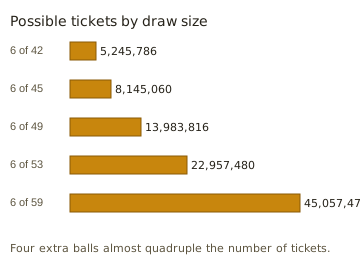
| Tickets, six from forty-two | 5,245,786 |
|---|---|
| Tickets, six from forty-five | 8,145,060 |
| Tickets, six from forty-nine | 13,983,816 |
| Tickets, six from fifty-three | 22,957,480 |
| Tickets, six from fifty-nine | 45,057,474 |
| Matching exactly three of six from forty-nine | 1 in 56.66 |
A draw game is the simplest object in this index to count and the hardest to reason about intuitively. Choosing six numbers from forty-nine gives 13,983,816 possible tickets, obtained by multiplying the six descending choices and dividing by the seven hundred and twenty ways any six numbers can be ordered. One of those tickets wins the jackpot, so the probability is one in roughly fourteen million, and no strategy about which numbers to pick alters it by any amount at all.
What most people underestimate is how fast that number moves. Going from forty-nine balls to fifty-nine, an apparently modest change, raises the ticket count from about fourteen million to about forty-five million. Draw designers use this deliberately: enlarging the pool makes jackpots roll over more often, and a jackpot that rolls over grows, and a growing jackpot sells more tickets than a frequently-won small one. Difficulty is a product feature.
The lower prize tiers are what keep a game feeling live, and they are much more common than the top one. Matching exactly three of six from forty-nine can happen 246,820 ways, because there are twenty ways to choose which three of your numbers hit and 12,341 ways for the other three drawn balls to come from the forty-three you did not pick. That is about one ticket in fifty-seven, frequent enough that a regular player will see it often and infer, wrongly, that they are close.
The commercial structure of a draw is quite unlike a table game. An operator does not carry a position against the players at all: the prize fund is set as a stated share of ticket sales, so the game's cost to players is fixed by policy rather than by pay-table arithmetic. Where a share of fifty per cent is returned in prizes, the expected value of a ticket is fifty per cent of its price whatever the numbers are, and the remainder covers prizes' administration, retail commission, duties and whatever public purposes the scheme was authorised to fund.
Two further features make a ticket worth less than the headline figure suggests. A jackpot shared between multiple winning tickets is divided, and popular number choices such as calendar dates are chosen by many people at once, so an unusual selection has the same chance of winning but a better chance of not sharing. And a large advertised jackpot is often an annuity total rather than an immediate sum. Neither changes the odds; both change the value.
Every draw entry in the index
- Match three of six from forty-nine1 in 56.66
DRAW / 246,820 WINNING TICKETS
- Six from forty-nine, jackpot1 in 13,983,816
DRAW / ALL COMBINATIONS
- Six from fifty-nine, jackpot1 in 45,057,474
DRAW / ALL COMBINATIONS
- Pick ten keno, all ten drawn1 in 8,911,711
DRAW / 20 OF 80 DRAWN
- Three-digit numbers game at 600 to 139.90%
DRAW / 1,000 OUTCOMES
- Prize pool fixed at half of ticket sales50.00%
DRAW / STRUCTURAL SHARE
Six from forty-nine. 49 × 48 × 47 × 46 × 45 × 44 = 10,068,347,520.
Divide by 6 × 5 × 4 × 3 × 2 × 1 = 720, giving 13,983,816 possible tickets.
Three-digit numbers game. One thousand equally likely results, paid at six hundred to one.
E = (1/1000 × 600) − (999/1000) = −399/1000 = −39.90%.