Dice games
THE GAMES
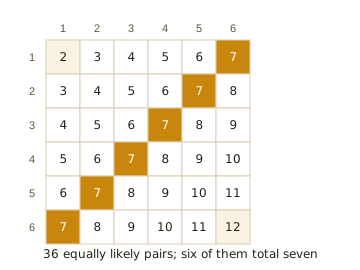
| Equally likely pairs | 36 |
|---|---|
| Ways to make seven | 6 |
| Ways to make six or eight | 5 each |
| Ways to make four or ten | 3 each |
| Ways to make two or twelve | 1 each |
| Pass line expected value | −1.41% |
| Free odds expected value | 0.00% |
The dice table looks chaotic and is in fact the best-documented arithmetic on any floor. Two dice produce thirty-six equally likely pairs, and every bet on the table is a statement about which of those pairs will appear, and in what order. Because the pairs are countable, so is the price of everything.
The pass line is the central bet and the most involved calculation. On the first roll seven or eleven wins immediately, which happens eight ways in thirty-six; two, three or twelve loses immediately, which happens four ways. Any other total becomes the point, and the bet then wins if that total repeats before a seven. Working through every point and every continuation, the probability of winning is 244 in 495, and the expected value on one unit is (244 − 251)/495 = −7/495, or 1.41 per cent.
Betting against the shooter is very slightly cheaper. The don't pass bet reverses the sequence but bars one losing outcome, usually the twelve, turning it into a push rather than a win. Of 1,980 equally weighted sequences it wins 949, loses 976 and pushes 55, giving an expected value of 27/1980, or 1.36 per cent. Reversing a bet and giving back a fraction of the reversal is how an operator sells both sides of the same event.
The free odds bet is the anomaly worth understanding. Once a point is established, a player may back it with an additional wager paid at exactly the true odds: two to one on a four or ten, three to two on a five or nine, six to five on a six or eight. That wager has an expected value of precisely zero. It cannot be made on its own, so the effect is to increase the money in play without increasing the operator's expected take, which lowers the average percentage across the player's total stake without lowering anything the operator collects.
The centre of the table is where the arithmetic turns against the player sharply. Hard eight pays nine to one on a bet that wins one way and loses ten, giving 1/11 or 9.09 per cent. Hard four pays seven to one and wins one way in nine, giving 11.11 per cent. Any seven pays four to one on a one in six shot and costs 16.67 per cent, the most expensive commonly offered bet in the family. The same dice, the same table, the same evening, and a twelvefold difference in cost depending only on which square the chips are placed.
Every dice entry in the index
- Free odds behind the line0.00%
DICE / TRUE-ODDS PAYOUT
- Don't pass1.36%
DICE / 1980 SEQUENCES / TWELVE BARRED
- Pass line1.41%
DICE / 495 SEQUENCES / PAYS 1 TO 1
- Place six or place eight1.52%
DICE / 11 DECIDING ROLLS / PAYS 7 TO 6
- Hard eight9.09%
DICE / 11 DECIDING ROLLS / PAYS 9 TO 1
- Hard four11.11%
DICE / 9 DECIDING ROLLS / PAYS 7 TO 1
- Any seven16.67%
DICE / 36 OUTCOMES / PAYS 4 TO 1
Place six. Only sixes and sevens decide the bet: five ways against six, so eleven deciding rolls.
Staking six units at a seven-to-six payout: E = (5/11 × 7) − (6/11 × 6) = −1/11 per six units = −1/66 = −1.52%.
Hard eight. Wins on four-and-four only; loses on any seven or any easy eight. One way against ten.
E = (1/11 × 9) − (10/11 × 1) = −1/11 = −9.09%.