Why the long run is not an opinion
THE MATHEMATICS
| 10 spins | 0.27 units |
|---|---|
| 100 spins | 2.70 units |
| 1,000 spins | 27 units |
| 10,000 spins | 270 units |
| Typical swing after 10,000 spins | about ±100 units |
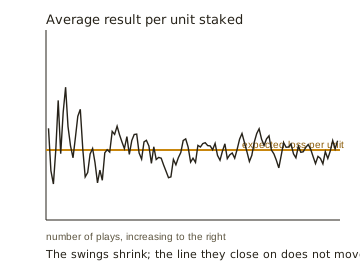
The law of large numbers is the reason a small, fixed advantage becomes a certainty rather than a tendency. It states that as the number of independent trials grows, the average result converges on the expected value. It does not say that luck evens out, and it does not say anything at all about what happens next. It says that the influence of any run of luck, good or bad, is diluted by everything that follows it.
Both quantities in that sentence grow, but at different speeds. Expected loss grows in proportion to the number of plays. The typical size of the swing around it grows only in proportion to the square root of the number of plays. After a hundred spins the swing is comfortably larger than the expected loss, and a player may easily be ahead. After ten thousand it is not, and being ahead has become improbable. Nothing changed in the game; the arithmetic simply stopped being hidden.
That asymmetry is the entire commercial position of an operator. A player may sit down for two hours, take a hundred decisions, and go home ahead. The operator is the counterparty to every table on the floor for every hour of every day, and is therefore always in the region of the graph where variance has been swamped. The operator does not need to win any particular bet, and does not care who wins it. It needs volume, and volume is what a floor of fast, repeatable games produces.
The most common misreading of this result is the gambler's fallacy: the belief that a wheel which has come up red six times is now due black. A wheel has no memory and no mechanism by which past spins could influence future ones. Convergence towards the expected value does not happen because deficits are repaid; it happens because they are outweighed. Six reds do not get cancelled, they get buried.
The mirror error is to conclude that a run proves the game is biased. Over enough spins, runs of six are entirely ordinary; a sequence with no long runs in it would be the surprising one. Telling a genuinely biased wheel from an unbiased one requires far more observations than most people imagine, which is one of the reasons regulators eventually turned to testing equipment directly rather than inferring anything from results.