Gaming machines
THE GAMES
| Three reels of twenty stops | 8,000 combinations |
|---|---|
| Three reels of twenty-two stops | 10,648 combinations |
| Three virtual reels of sixty-four positions | 262,144 combinations |
| This site's worked example, return | 86.75% |
| This site's worked example, edge | 13.25% |
| Machine set to a 95% return | 5.00% per spin |
A reel machine is a pay table wearing a costume. Strip away the display and it is a device that selects one combination from a fixed, countable set and pays according to a published schedule. Three reels of twenty stops give eight thousand combinations; three of twenty-two give ten thousand six hundred and forty-eight. Once the symbol counts and the schedule are fixed, the return is fixed too, and it can be computed exactly rather than measured.
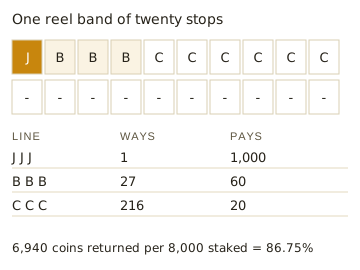
The worked example on this page uses three identical bands of twenty stops: one jackpot symbol, three bars, six cherries and ten blanks. Three jackpots occur once in eight thousand spins, three bars twenty-seven times, three cherries two hundred and sixteen times. At payouts of one thousand, sixty and twenty coins, the machine returns 6,940 coins for every 8,000 staked: 86.75 per cent, an edge of 13.25 per cent. No hidden mechanism is required and none is present.
The change that made modern machines possible was breaking the link between the physical reel and the probability. On an early machine every stop was equally likely, so a large jackpot required either very long reels or a very modest prize. Mapping a large set of internal positions onto a smaller set of visible stops let a designer make one symbol rare without making the reel long: the top symbol might occupy one internal position in sixty-four while blanks occupy many, so the jackpot becomes one in 262,144 while the reel still shows twenty-two symbols.
This mapping is also the source of the near-miss. A jackpot symbol can be assigned only a few internal positions while the positions immediately above and below it are assigned many, so the symbol appears just off the payline far more often than it appears on it. The display is telling the truth about the reel and nothing at all about the probability, which is unchanged by how close anything looked.
Return percentage is a long-run figure and says nothing about a session. A machine set to return ninety-five per cent has an edge of five per cent, but a single spin returns nothing or a multiple, and volatility, meaning how the return is distributed between many small wins and rare large ones, is a separate design choice that can be varied while the return figure stays identical. Two machines with the same advertised return can feel entirely different and cost the same.
Every machine entry in the index
- Return set to ninety-five per cent5.00%
MACHINE / PER SPIN
- Return set to ninety per cent10.00%
MACHINE / PER SPIN
- This site's worked three-reel pay table13.25%
MACHINE / 8,000 COMBINATIONS
- Return set to eighty-five per cent15.00%
MACHINE / PER SPIN
- Three reels of twenty stops, top symbol1 in 8,000
MACHINE / COMBINATION COUNT
- Three reels of twenty-two stops, top symbol1 in 10,648
MACHINE / COMBINATION COUNT
- Three virtual reels of sixty-four positions1 in 262,144
MACHINE / COMBINATION COUNT
The worked example in full. Bands of 1 jackpot, 3 bars, 6 cherries, 10 blanks; 20 × 20 × 20 = 8,000 combinations.
Three jackpots: 1 × 1 × 1 = 1 way, pays 1,000 → 1,000 coins.
Three bars: 3 × 3 × 3 = 27 ways, pays 60 → 1,620 coins.
Three cherries: 6 × 6 × 6 = 216 ways, pays 20 → 4,320 coins.
Total returned 6,940 of 8,000 staked = 86.75%; the edge is the remaining 13.25%.